


Many healthcare providers recommend broken ankle exercises as a part of the recovery plan. These are meant to help restore strength, mobility, and stability in the lower leg joint. If your doctor’s given you the go-ahead or you’re looking for ideas to help a friend or family member, we’ve shared a few movements below that might come in handy.
Before You Start
It’s best to check with your GP or physiotherapist. They’ll know what is safe for your ankle (or someone else’s), so you don’t risk doing too much too soon.
When you do begin, keep the movements gentle and low-impact. Go at a pace that doesn’t put too much pressure on your ankle. There’s no rush here.
Oh, and one handy thing to have around is a resistance band. This practical tool adds light strength and mobility work without overdoing it. You might also find this guide on how to use resistance bands helpful.
Broken Ankle Rehab Exercises to Try at Home
These moves are categorised into three sections, but all support the ankle as it recovers, helping you get back on your feet sooner. Ready?
Strength
Build up muscle around the joint with these helpful but straightforward strength exercises:
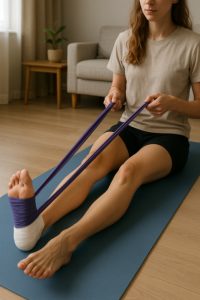
a.) Resistance band pushes
- Sit on the floor or a non slip yoga mat with your legs stretched.
- Loop a resistance band around the ball of your foot and hold the ends.
- Push forward against the band, like you’re pressing a pedal, then slowly return to the start.
Do 10 to 12 reps on the injured side, rest, then repeat for 2 to 3 sets.
b.) Towel scrunches
- Lay a small towel flat on the floor in front of a chair.
- Sit down, place your bare foot on it, and use your toes to scrunch it up toward you.
Do this 10 times, then smooth the towel and do another round.
Mobility (includes plantar flexion exercises)
After a broken ankle, it’s common to feel a bit stiff or limited in how much you can move your foot. These movements help loosen the joint and improve the range of motion.
a.) Ankle circles
- Sit or lie down with your leg slightly raised. A cushion or rolled-up towel under your calf can help.
- Roll your ankle in a circular motion (do so slowly) 10 times in one direction, then switch and go the other way.
Take your time with each circle.
b.) Plantar flexion
- Rest in a seated position with your leg straight in front.
- Wrap a towel or physio band, loop it under your foot, and grab both sides.
- Point your toes forward as far as feels comfortable, then slowly bring them back.
Go for 10 to 12 reps, and aim for 2 to 3 sets. Plantar flexion exercises are great for plantar fasciitis or general tightness in the foot.
Stability
These stability exercises focus on balance and control, crucial for walking, turning, or standing. Put simply, they can help your ankle get used to bearing weight again.
a.) Standing weight shifts
- Stand with your feet about hip-width apart.
- Shift your weight from one foot to the other, side to side, nice and steady.
Do this for around 10 to 15 reps in each direction. Tip: Stand near a wall or the back of a sturdy chair for support, ideally at the start.
b.) One-leg stands (when ready)
Once you feel more confident, try standing on your recovering leg for a few seconds.
- Start with 5–10 seconds and slowly build up from there.
- Aim for a few rounds on each leg, and keep something nearby to hold onto if needed.
It’s a simple move, but great for rebuilding joint stability and waking up those smaller support muscles.
Round-up
Recovering from a broken ankle doesn’t happen overnight. It’s normal for progress to feel slow some days, but even a few minutes of gentle movement each day can go a long way. Stay consistent, listen to your body, and give it time to build strength and control.
Disclaimer: This isn’t medical advice, but simply a guide to support the recovery journey. Always check with a medical professional to make sure it’s safe to start these broken ankle exercises—especially if there’s any pain, swelling, or you’re unsure what’s right for the stage of healing.
Physioroom offers a range of ankle supports and braces for rehab and recovery use.