

What is a Hamstring Muscle Strain?
A hamstring injury is common in sports and are sometimes known as a ‘pulled hamstring’. The term ‘pulled muscle’ comes from the description of how the injury takes place. Usually, the hamstring muscle is forcibly stretched beyond its limits and the muscle tissue becomes torn. A tear in the hamstring muscle is referred to as a hamstring strain by medical professionals and depending on its severity it is classified as a first, second or third degree strain:
- a first degree strain is damage to a few muscle fibres,
- a second degree strain is damage to a more extensive number of muscle fibres,
- a third degree strain is a complete rupture of the muscle itself.
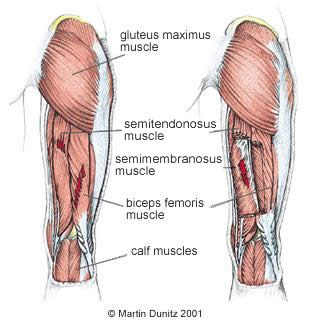
The hamstring muscle group comprises three muscles – biceps femoris, semitendonosus and semimembranosus. The action of these muscles is to bend the knee and extend the hip. Semitendonosis and biceps femoris also have a rotational influence on the knee and lower leg. Semitendonosis attaches into the medial aspect of the tibia via the pes anserine and medially rotates the knee whereas biceps femoris attaches laterally and aids the lateral rotation of the Tibia.
Signs & Symptoms of a Hamstring Injury
With a grade one hamstring strain the signs may not be present until after the activity is over. There may be a sensation of hamstring cramp or hamstring tightness and a slight feeling of pain when the muscles are stretched or contracted.
With a grade two hamstring strain there is immediate pain which is more severe than the pain of a grade one injury. It will make the individual stop mid-run and is confirmed by pain on stretch and contraction of the muscle. A grade two Hamstring strain is usually sore to touch.
A grade three hamstring strain is a very serious injury. There is an immediate burning or stabbing pain and the athlete is unable to walk without pain. The muscle is completely torn and there may be a large lump of muscle tissue above a depression where the tear is. After a few days with grade two and three injuries a large bruise will appear below the injury site caused by the bleeding within the tissues.
Hamstring Injury Treatment
What you can do
- Consult a sports injury expert
- Apply ice packs to relieve pain
- Apply compression bandage to control bleeding & swelling
- Use resistance bands for muscle strengthening exercises
- Wear compression shorts or a thigh support for reassurance during rehabilitation
The immediate treatment of a hamstring muscle injury consists of the RICE protocol – rest, ice, compression and elevation (never apply ice directly to the skin). This is aimed at reducing the bleeding and damage within the hamstring muscle tissue. Resting may be the common sense approach, but it is one that is often ignored by competitive athletes. This is unwise, since it does not take much to turn a grade one hamstring strain into a grade two, or a grade two hamstring strain into a grade three. As a general rule, grade one hamstring strains should be rested from sporting activity for about 3 weeks and grade two injuries for about 4 to 6 weeks. In the case of a complete rupture, the hamstring muscle will have to be repaired surgically and the rehabilitation afterwards will take about 3 months.
Regardless of the severity of the hamstring injury the treatment in the first few days is the same. The hamstring should be rested in an elevated position with an ice pack applied for twenty minutes every two hours, if practical (never apply ice directly to the skin). A compression bandage should be applied to limit bleeding and swelling in the tissues. After the early stages have been spent resting, more active rehabilitation can be started. Compression shorts or thigh supports may be used to support the injury and provide reassurance as activity is re-started.
Once pain-free, gentle resistance exercises and stretching are important as they help to align the scar tissue that forms during the healing process. By aligning the scar tissue along the normal lines of stress the tensile strength of the hamstring is enhanced.
At first gentle resistance is provided by a therapist, but as the muscle gets stronger then resistance bands can provide more of a challenge. The sets and repetitions are gradually increased and eventually core strengthening can be started.
Core strength and core stability exercises can improve muscle function across the trunk and pelvis and this can reduce the risk of hamstring injury. Increased gluteal strength will also lessen the load placed upon the hamstring group in high speed, powerful or explosive movements. Core strength exercises on a mat using a swiss ball and resistance bands are ideal. Once core strength and hamstring strength are improved, then a return to functional activity is possible. With a grade one hamstring strain gentle jogging can be initiated between seven and nine days after injury and straight line sprinting is usually started after 3 weeks. Many people find that compression shorts and thigh supports provide reassurance during this active rehabilitation.
Hamstring Injury Prevention
What you can do
- Warm up before sporting activities
- Cool down following sporting activities
- Stretch regularly to maintain muscle length
- Replenish carbohydrates during sporting activity with energy bars & gels
- Wear compression shorts or a thigh support to retain muscle warmth
The following measures may have the effect of reducing the risk of sustaining a Hamstring muscle strain:
Warm up prior to matches and training is thought to decrease muscle stretch injuries because the muscle is more extensible when the tissue temperature has been increased by one or two degrees. A good warm up should last at least 20 minutes – starting gently and finishing at full pace activity. Practising sport specific activities helps tune coordination and prepare mentally for competition. Compression shorts or a thigh support can be helpful for retaining muscle tissue temperature, ensuring that the tissue remains extensible even in colder weather.
Recovery after training sessions and matches can be enhanced by performing a cool down. This is thought to help muscles get rid of waste products. This is also the ideal time to do stretching exercises, whilst the muscle is warm and pliable.
Maintaining good muscle strength and flexibility may help prevent muscle strains. Muscle strength allows a player to carry out match activities in a controlled manner and decreases the uncoordinated movements which can lead to injury. The stronger the muscle is, especially when eccentrically loaded (lengthened) the more tolerant it is to the demands of intense sport and activity. A physiotherapist can help identify any muscle imbalances that may make an individual more susceptible to hamstring injuries. Weak glute muscles may place greater stress on the hamstrings to extend the hip. Tight or dominant quadriceps may also place the hamstrings under excess strain. Therefore a thorough assessment can help individualise a rehab programme. Tight muscles are associated with strains. Stretching sessions using a gym mat can be helpful to maintain muscle length and prevent injury.
Diet can have an affect on muscle injuries. If a player’s diet is high in carbohydrate in the 48 hours before a match there will be a adequate supply of the energy that is necessary for muscle contractions. However, if the muscles become short of fuel, fatigue can set in during training or matches. This fatigue can predispose a player to injury. Carbohydrate can be replenished during training and matches by taking energy bars and gels.
Rehabilitation for a Hamstring Injury
Grade One Hamstring Strain Rehabilitation
Days 1 to 5
RICE protocol – rest, ice, compression and elevation (never apply ice directly to the skin). The hamstring should be rested in an elevated position with an ice pack applied for twenty minutes every two hours, if practical (never apply ice directly to the skin). A compression bandage should be applied to limit bleeding and swelling in the tissues. After the early stages have been spent resting, more active rehabilitation can be started.
Days 6 to 10
Gentle Hamstring stretching can begin, sitting on a gym mat and slowly bending forward, sliding the hands down the thighs. The patient should stop when the tension of a stretch in the hamstring begins to be felt – the position should then be held for thirty seconds. Repetitions x 3. This should be pain-free.
Gentle resistance exercises can begin under the supervision of a qualified therapist. Early, gentle, pain free stretching and strengthening against light force provided by the therapist can help to align the scar tissue, which is forming to heal the muscle tear. This ultimately produces a stronger scar.
Days 11 to 14
Free exercises to strengthen the hamstring muscles can begin.
The patient starts by sitting on the gym mat and sliding the heel up to the bottom. Repetitions x 20, 3 times each day. If this can be done without pain, progress to the next position can be made.
The patient lies on their front and brings the heel up to the bottom. Repetitions x 20, 3 times each day. If this can be done without pain, progress to the next position can be made.
Standing, the patient brings the heel up to the bottom. Repetitions x 20, 3 times each day.
Hamstring stretches are also continued.
Days 15 to 17
Intermittent jogging and walking can begin.
5 minutes at first, then build up in 5 minute increments. Once the patient can do 15 minutes they should build up to to half pace running.
Squats can begin – repetitions x 20, 3 times daily.
Hamstring curls using a resistance weight machine can also begin.
Everything should be pain-free.
Day 18+
Backward running can begin.
If pain-free, the patient progresses to full pace forward running.
The patient continues stretching and strengthening exercises.
The patient begins sports specific activities.
Grade Two Hamstring Strain Rehabilitation
Days 1 to 5
RICE protocol – rest, ice, compression and elevation (never apply ice directly to the skin). This is aimed at reducing the bleeding and damage within the muscle tissue.
Days 6 to 11
Gentle hamstring stretching can begin, sitting on a gym mat and slowly bending forward, sliding the hands down the thighs. The patient should stop when the tension of a stretch in the hamstring begins to be felt – the position should then be held for thirty seconds. Repetitions x 3.
This should be pain-free.
Each day the patient should be able to stretch a little further.
Gentle resistance exercises can begin under the supervision of a qualified therapist. Early, gentle, pain free stretching and strengthening against light force provided by the therapist can help to align the scar tissue, which is forming to heal the muscle tear. This ultimately produces a stronger scar.
Days 12 to 19
Free exercises to strengthen the hamstring muscles can begin.
The patient starts by sitting on the gym mat and sliding the heel up to the bottom. Repetitions x 20, 3 times each day. If this can be done without pain, progress to the next position can be made.
The patient lies on their front and brings the heel up to the bottom. Repetitions x 20, 3 times each day. If this can be done without pain, progress to the next position can be made.
Standing, the patient brings the heel up to the bottom. Repetitions x 20, 3 times each day.
Hamstring stretches are also continued.
Days 20 to 26
Intermittent jogging and walking can begin.
5 minutes at first, then build up in 5 minute increments. Once the patient can do 15 minutes they should build up to to half pace running.
Squats can begin – repetitions x 20, 3 times daily.
Hamstring curls using a resistance weight machine can also begin.
Everything should be pain-free.
Day 27+
Backward running can begin.
If pain-free, the patient progresses to full pace forward running.
The patient continues stretching and strengthening exercises.
The patient begins sports specific activities.
Grade 3 Hamstring Strain (Complete Rupture) Rehabilitation
Follow the advice of an orthopaedic consultant.