

What is a Rotator Cuff Injury?
A rotator cuff injury is a common cause of shoulder pain. Injury to the rotator cuff will usually begin as inflammation, often referred to as rotator cuff tendonitis. The rotator cuff muscles (Subscapularis, Supraspinatus, Infraspinatus and Teres minor) are small muscles situated around the shoulder joint. Although they have individual actions, their main role is to work together to stabilise the humeral head (ball) in the shoulder socket
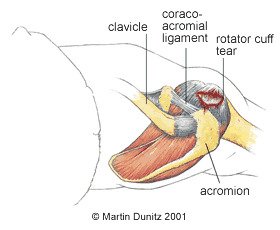
People are often told that they have injured one particular rotator cuff muscle or tendon, with the most common diagnosis being supraspinatus tendonitis. However, it is unlikely that the problem is with just one of the muscles in isolation. The world’s top shoulder surgeons refer to such conditions as a ‘rotator cuff injury’ and consider the picture as a whole.
Although the rotator cuff can be injured by a single traumatic incident, this is not common. Injury to the rotator cuff will usually begin as inflammation (tendonitis) caused by some repetitive form of micro trauma (a small but continuous source of irritation). If the cause of the inflammation is not addressed, and continues over a long period of time, partial tears may develop in the cuff that could eventually become complete tears (a tear all the way through one or more of the rotator cuff muscles).
Three Main Causes of Micro Trauma to the Rotator Cuff:
Primary Impingement
The ‘Coraco-Acromial arch’ forms a bridge over the rotator cuff. It is made up of bones and ligaments and is lined by a sac of fluid called the Subacromial bursa. The space under the bridge that is available for the rotator cuff is called the subacromial space. Many people will have a naturally small subacromial space, which is just bad luck, but the space can also be reduced by conditions such as osteoarthritis, or poor posture in which the upper back and neck have become more rounded in shape. Whatever the cause of this small subacromial space, repetitive overhead activities (such as throwing a basketball or dusting high shelves) can cause the rotator cuff to become continuously squashed against the coraco-acromial arch, causing inflammation of the cuff.
Secondary Impingement
Many people will have what is called shoulder instability (a lax shoulder joint). This laxity may have been present since birth or may be due to an injury. Often it will have occurred over time due to repetitive overhead activity, poor posture or inactivity. Due to this instability, the rotator cuff has to overwork to stabilise the shoulder, causing it to become inflamed. Eventually, the rotator cuff will become weak and tired, and will not be able to prevent the humeral head from squashing up against the coraco-acromial arch. Because this type of impingement is not due to a small subacromial space, it is called secondary impingement.
Overstraining
During forceful throwing actions (e.g. tennis service, pitching and throwing), the rotator cuff has to work very hard. With repetitive throwing, the cuff is prone to being overloaded, resulting in inflammation and tissue breakdown.
Signs & Symptoms of a Rotator Cuff Injury
Symptoms of rotator cuff injury include weakness, loss of full movement and shoulder pain. The amount of pain will depend on the extent of the injury. Patients with early-stage inflammation may only have pain with overhead activities, for instance when they reach up to a kitchen cupboard, while those with a rotator cuff tear may not be able to sleep because of the pain.
Physiotherapists have a number of physical tests designed to diagnose the presence and severity of rotator cuff injury. It is also important to look for signs of shoulder instability. X-rays can give clues as to the presence of a rotator cuff injury but an MRI scan is the investigation method of choice to determine whether a tear is present. An ultrasound scan may be just as effective if carried out by an experienced sonographer.
Rotator Cuff Injury Treatment
What you can do
- Consult a sports injury expert
- Apply cold or hot packs/therapy to help relieve pain
- Use anti-inflammatory gel for pain relief
Tears of the rotator cuff are best treated by surgical repair. Physiotherapy is often effective in treating acute (short-term) inflammation and chronic (long-term) degeneration of the cuff where a tear is not present. The first aim of treatment is to reduce the amount of inflammation using ice therapy (never apply ice directly to the skin) and anti-inflammatory medication prescribed by a doctor. Anti-inflammatory gel may be more appropriate where anti-inflammatory tablets are not well tolerated. For those who want to continue with sports and work activities a neoprene shoulder support can provide support and reassurance.
Ice packs relieve pain and reduce bleeding in the damaged tissue. Cryotherapy is the most effective method of providing ice therapy and is the professional’s choice for shoulder injuries. It is ideal for home use as it can provide continuous ice cold water and compression for 6 hours. This can significantly reduce shoulder pain and swelling.
A corticosteroid injection (an injection of a naturally occurring substance that can slow down inflammation) that bathes the rotator cuff, rather than being injected directly into it, is advocated by some doctors. However, even this may carry a risk of causing further damage and should be used with caution.
Once the inflammation and pain has settled, exercises to regain full movement can begin, followed by a carefully-graded strengthening and stabilising programme. Resistance bands can be very useful for this. Faults in sporting technique, such as posture and shoulder blade stability, that may have caused the problem in the first place must also be rectified.
Operative treatment of chronic inflammation and degeneration of the rotator cuff may be necessary if no progress is made with physiotherapy. The use of surgery aims to enlarge the subacromial space (subacromial decompression), thus reducing the risk of impingement.
Rotator Cuff Injury Prevention
What you can do
- Use resistance bands for strengthening exercises
- Warm up before sporting activities
- Cool down following sporting activities
For athletes, attention must be paid to flexibility, strength and endurance of the shoulder muscles, ensuring that the muscles of the scapula are not neglected. Small intricate movements may need to be trained in order to improve the performance of larger scale movements. Learning the correct technique and choosing proper equipment are also important. In addition, any increases in the amount of training or competition must be gradual so as not to overload the rotator cuff. Resistance bands are ideal for shoulder strengthening.
Postural education may also be important as prolonged sitting, computer work or driving can all lead to a more rounded position of the upper back and shoulders, which can further reduce the subacromial space. A physiotherapist will provide exercises and advice on everyday activities to improve posture.
Finally, a proper warm up and cool down may also help to prevent injury.