


Abdominal Strain Injury Explained
Abdominal pain may be due to a Stomach muscle strain sustained during sport. Alternatively it is not uncommon to sustain an abdominal strain during stomach exercises. In running and cycling the exertion of going uphill can cause a flexed posture where the stomach muscles are contracting hard, when the effort is over and the athlete adopts a more extended position a strain on the abdominal muscles occurs and the transition can cause injury.
A muscle strain refers to a tear within the muscle. Usually the muscle is forcibly stretched beyond its limits and the muscle tissue becomes torn. Depending upon its severity it is classified as a first, second or third degree strain:
- a first degree strain is damage to a few muscle fibres
- a second degree strain is damage to a more extensive number of muscle fibres
- a third degree strain is a complete rupture of the muscle itself
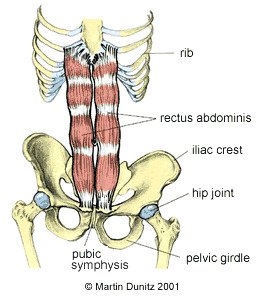
The abdominal muscle group comprises the rectus abdominis, internal obliques and external obliques. Of these, the rectus abdominis is most prominent, and can be seen in some individuals as a ‘six pack’. The function of the Rectus Abdominus muscle is to flex the spine, as demonstrated during a sit up. The internal obliques and external obliques work together to produce twisting movements of the trunk. These muscles can be damaged during a sudden contraction, such as when twisting in an uncoordinated manner.
Abdominal Strain Signs & Symptoms
With a grade one abdominal muscle strain the signs of injury may not be present until after the activity is over. There may be a sensation of cramp or tightness and a slight feeling of pain when the muscles are stretched or contracted. A grade one strain may present as a ‘stitch’ like discomfort.
With a grade two abdominal muscle strain there is immediate pain which is more severe than the pain of a grade one injury. It is confirmed by pain on stretch and contraction of the muscle. A grade two abdominal strain is usually sore to touch.
With a grade three abdominal strain there is an immediate burning or stabbing pain and the athlete is unable to move without pain. The muscle is completely torn and there may be a bulge of soft tissue through the muscle layer – this is known as a hernia. In the case of grade two and three injuries, a bruise may appear after a few days below the injury, caused by bleeding within the tissues.
Abdominal Strain Treatment
The immediate treatment for any muscle injury consists of rest, ice and compression. Ice packs can be applied for periods of twenty minutes every couple of hours (never apply ice directly to the skin as it can cause an ice burn). The ice packs relieve pain and reduce bleeding in the damaged tissue.
Resting may be the common sense approach, but it is one that is often ignored by competitive athletes. This is unwise, since it does not take much to turn a grade one strain into a grade two, or a grade two strain into a grade three. As a general rule, grade one injuries should be rested from sporting activity for about 3 weeks and grade two injuries for about 4 to 6 weeks. In the case of a complete rupture, the muscle may have to be repaired surgically and the rehabilitation afterwards will take about 3 months.
Abdominal Strain Prevention
The following measures may have the effect of reducing the chances of sustaining a muscle strain:
Warm up prior to matches and training is thought to decrease muscle stretch injuries because the muscle is more extensible when the tissue temperature has been increased by one or two degrees. A good warm up should last at least 20 minutes – starting gently and finishing at full pace activity. Practising sport specific activities helps tune coordination and prepare mentally for competition.
Recovery after training sessions and matches can be enhanced by performing a cool down. Ideally the cool down session should take place the day after the activity. This is thought to help muscles get rid of waste products. This is also the ideal time to do stretching exercises.
Maintaining good muscle strength and flexibility may help prevent muscle strains. Muscle strength allows a player to carry out match activities in a controlled manner and decreases the uncoordinated movements which can lead to injury. Core strength exercises using a swiss ball are ideal. Tight muscles are associated with strains and stretching on a mat should also be practised to maintain muscle length and prevent injury. Stronger muscles, especially during rotational movements will help protect against sudden injuries. A physiotherapist can set a programme to specifically strengthen the intricate movements needed for your sport or hobby.
Diet can have an effect on muscle injuries. If a player’s diet is high in carbohydrate in the 48 hours before a match there will be an adequate supply of the energy that is necessary for muscle contractions. However, if the muscles become short of fuel, fatigue can set in during training or matches. This fatigue can predispose a player to injury. Carbohydrate and fluids can be replenished during training and matches by taking an energy drink or energy gel periodically during activity.