

Medically reviewed by Katie Knapton, MSCP HCPC on 29th October 2021
What is Spondylolysis?
A stress fracture, medically known as spondylolysis, is the most common overuse injury of the lower back in sport. This condition is classified as either a bone stress reaction or a stress fracture of the lower back. It is especially common in growing adolescents and symptoms are often related to the ‘growth spurt’. Cricket fast bowlers, possibly due to the high force twisting motion, appear to be particularly susceptible to spondylolysis, with a reported prevalence of 55% in some teams.
At the base of the back there are five lumbar vertebrae. The most common site for spondylolysis is the bottom-most lumbar vertebra, called L5, where the mobile lumbar spine meets the fixed pelvis. This is because this vertebra is subject to most stress during sports.
The lumbar vertebra consists of a round block of bone at the front, known as the vertebral body, and a bony ring at the back. Three bony ‘process’ stick out from this ring and provide a place for muscles to attach. The area that is affected by spondylolysis is a part of the bony ring known as the ‘pars’. It is not clear why, but the pars area appears to be a weak spot in the vertebra and repetitive stress to the area can lead to micro trauma and eventual fracture of the pars, resulting in a slipping forward of the vertebral body over the one below.
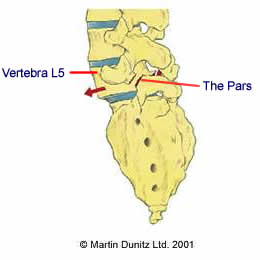
The lumbar spine is required to bear large loads, due to the interaction of body weight with forces generated by sporting movements that involve large muscle forces. These forces are transmitted via the bones of the spine. Bone fatigue occurs in the pars as a loss of bone strength and stiffness due to repeated loading. This repeated loading is of less force than it would take to produce a traumatic fracture, but because it is repeated over a period of time it eventually causes bone damage. This fatigue eventually causes microscopic cracks or micro fractures to occur across the pars.
In healthy bone, if damage is not excessive, a biological process called remodeling occurs and new bone is deposited to heal the damage. In order for remodeling to occur, the body must be given adequate rest to recover from the repeated loading that occurs during sport. However, if the damage is excessive and the remodeling cannot keep pace with the damage, then microscopic failures (fractures) occur. This results in a pars fracture, causing the slipping of the vertebral body on the one below, known as spondylolysis.
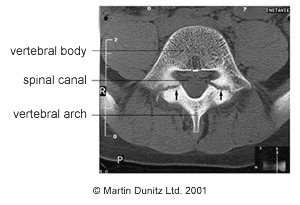
An MRI scan of the fifth lumbar vertebra, seen from the top, shows bilateral (left and right sided) fractures of the Pars.
Spondylolysis Signs & Symptoms
This condition is most common in adolescents and is quite rare beyond this age group. Spondylolysis is characterised by an ache in the lower back which is exacerbated by sporting activities and eased by rest. Typically, it is sore when the patient bends backwards and closes down the joints between the vertebra. This is particularly felt if standing on one leg. If spondylolysis is suspected, a GP may decide to refer the patient for a scan to confirm the diagnosis.
Spondylolysis Treatment
- Consult a sports injury expert
- Wear a back brace to provide immobilisation & support
- Exercise with a swiss ball to increase lower back muscular stability
- Maintain fitness in the pool with a buoyancy aid
- Use a seat support to improve posture whilst sitting
- Exercises to strengthen spine and surrounding muscles
In most cases, complete rest is the treatment of choice. This would usually be for a period of 6 weeks, to allow the bone to heal. A back brace can be helpful to provide support and partial immobilisation. It also acts as a reminder to young people that they shouldn’t do too much activity.
As the bone is healing a progressive exercise program may commence, under the supervision of a chartered physiotherapist. This usually starts with exercises to increase the muscular stability in the lower back – a swiss ball can be very helpful as it allows partial weight bearing through the spine but promotes stability in the area, important to recover and prevent re-injury. Non weight bearing exercise such as pool running using a buoyancy belt can also be useful during this period as this is an excellent method of maintaining cardiovascular fitness.
As the bone is healing a progressive exercise program may commence, under the supervision of a chartered physiotherapist. This usually starts with non-weight bearing exercises to increase the muscular stability and strength in the lower back and especially the core muscles. This is usually monitored closely and pain is avoided.
Muscle Exercises for the Back
It is important that the correct diagnosis has been identified and rehabilitation initially starts with an appropriate period of rest and then a graduated strengthening programme is introduced which is sport and person specific. It is important to allow healing otherwise long term pain and back problems can be an issue and limit the potential to progress in a sport.
Spondylolysis Prevention
Sporting activities should be practiced on grass if possible. Compared to Astroturf and concrete, grass has some degree of ‘give’ in it that reduces the forces that are transmitted through the spine. Competitive games should be limited to 30 each season and practice sessions should be monitored and extended gradually in frequency, duration and intensity. It is important that adequate rest periods are taken between training sessions and matches, and practices should not be overdone, particularly when participating in activities such as taking throw-ins in football and fast bowling in cricket.
Adequate shoes should be worn to improve shock absorption and footwear should be replaced frequently throughout a season to ensure less impact is transmitted to the joints and spine.
The posture should be monitored. By slouching in a poor posture the back muscles become ineffective in protecting the back from injury. Sitting slumped in front of a computer for long periods should be avoided. The back should be well supported with a seating support cushion and regular breaks should be taken.
In the long term, good posture and engaging with a variety of training techniques and exercises are used to improve the strength and mobility of the spine and reduce the possibility of overload.