

Tibialis Posterior Pain Explained
Tibialis posterior pain is a common running injury that can lead to acquired flat foot and foot pain in later life. The tibialis posterior tendon can become inflamed, partially torn or ruptured, causing pain behind the bony prominence on the inside of the ankle. A direct kick to the tibialis posterior tendon can trigger the condition in football (soccer) players, but tibialis posterior tendon problems usually occur gradually due to overuse in runners.
The tibialis posterior muscle arises from the back of the shin bone, passes down the inside of the ankle as a tendon and inserts into the tarsal bones in the middle of the foot. Together with a couple of other tendons (flexor hallucis longus and flexor digitorum longus) the tibialis posterior passes just behind the bony prominence (malleolus) on the inside of the ankle and this is often where the problem arises. The area behind the malleolus is referred to as the ‘tarsal tunnel’ as it also encloses nerves and blood vessels supplying the foot.
The function of the tibialis posterior muscle is to help the calf muscles push the foot down, as in the ‘toe off’ phase of walking and running, and also to turn the foot inwards. If a person has a heel that turns out at the bottom (everted rear foot), causing the foot to roll inwards (pronate), then more strain is placed on the tibialis posterior tendon and it can become prone to injury. As the tendon reaches the tarsal tunnel it curves around the bony prominence, creating a weak spot and this is often the area of pain.
The condition can also occur without postural malalignments, where someone has done a lot of running around tight bends or on a road with a camber. Often this doesn’t occur dramatically, but is the result of repeated overuse – with every step that is taken the tendon is overloaded and becomes inflamed as it tries to support the arch. The inside of the ankle becomes painful and a rest from running may be enforced.
The tibialis posterior tendon plays an important role in providing support to the arch on the inside of the foot, and its correct functioning is therefore very important. If a problem with the tibialis posterior tendon is ignored, and a person carries on with sporting activities, it can lead to a complete rupture of the tendon which has to be surgically repaired. This can have a major effect on foot biomechanics, with the inside arch of the foot losing support and ‘collapsing’. It is therefore very important that tibialis posterior tendon problems receive appropriate early treatment including strengthening and stretching.
Longstanding tibialis posterior dysfunction can cause fallen arches and serious foot pain and ankle pain. This acquired flat foot is a major cause of mobility problems in older people.
Signs & Symptoms of Tibialis Posterior Pain
If the tibialis posterior tendon and its surrounding sheath become inflamed there is pain on the inside of the ankle during movements, particularly pushing the foot downwards (plantar flexion) and turning the sole of the foot inwards (inversion).
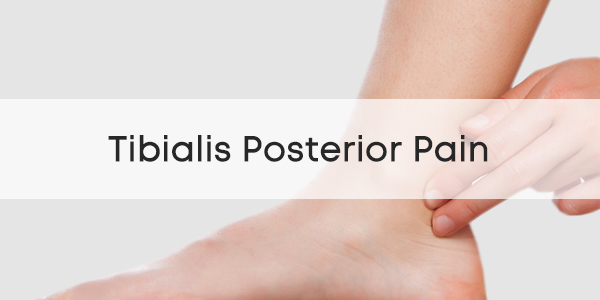
The attachment of the tibialis posterior tendon into the navicular bone (where the shoe laces are tied) can become painful to touch, as can the tibialis posterior tendon itself. This commonly occurs behind the bony lump on the inside of the ankle (the medial malleolus) and is often accompanied by swelling. In some cases this area will produce a creaking sound during movements.
The diagnosis of tibialis posterior syndrome is usually straightforward for the doctor or chartered physiotherapist. However, the patient sometimes takes a little convincing that their pain is not coming from the medial malleolus itself. The involvement of ankle joint and bony structures can be ruled out with an MRI scan. The flexor hallucis longus and flexor digitorum longus tendons which run close to the tibialis posterior may also be involved and require treatment. Sometimes due to the close proximity of the tibial nerve, pins and needles or burning pain may also be felt around the inside heel.
Treatment for Tibialis Posterior Pain
- Consult a sports injury expert
- Apply ice packs/cold therapy for pain relief
- Use anti-inflammatory gel for relief of symptoms
- Use a foot brace to correct flat feet & fallen arches
In the acute stage, when tibialis posterior dysfunction has just developed, the P.R.I.C.E protocol should be followed – Protection Rest Ice Compression Elevation (never apply ice directly to the skin) – to combat the inflammatory process within the tibialis posterior tendon sheath. Ice packs applied for twenty minutes every two hours can relieve pain and non steroidal anti inflammatory drugs (NSAIDs) prescribed by a doctor can be helpful at this stage. Anti inflammatory gel can also relieve tibialis posterior symptoms.
In more long-standing cases, it may be necessary to use an injection of a mixture of corticosteroid and a local anaesthetic, into the tendon sheath to help relieve the symptoms. It is important that this is followed by a period of complete rest and some doctors prefer immobilisation for a period of weeks.
It is not just a case of returning to sport once the person is pain free. Abnormal lower leg mechanics are usually involved in tibialis posterior tendon problems and these should be addressed with a physiotherapy assessment. Often the forefoot rolls over (pronates) too much and this forces the tibialis posterior tendon to overwork. Less often, the ligaments that support the foot on the inner side are dysfunctional, leading to overstrain on the tibialis posterior tendon. Both of these scenarios can benefit from the use of the an ankle brace or an arch support insole, which provides comfortable support to the arch of the foot and take the strain off the tibialis posterior tendon. These are also very useful in older people who have acquired flat foot due to fallen arches secondary to tibilais posterior dysfunction where it can help to restore mobility.
In younger patients, before returning to sport, it is wise to work through an eccentric strengthening program for tibialis posterior under the supervision of a chartered physiotherapist. This allows the tendon to adapt gradually to the demands of sport.
Tibialis Posterior Pain Prevention
- Maintain a running log to track progression
- Reduce tendon stress with shock absorbing insoles
- Wear orthotics to support the arch
Tibialis posterior dysfunction is often caused by doing too much, too soon. When beginning or changing an exercise programme, any increases in activity must be gradual. For example, an increase from running 2 miles per day one week to running 10 miles per day the next week cannot be undertaken without putting the body at risk of a number of problems. Maintaining a running log can resolve this problem.
The amount of stress being placed on the tibialis posterior tendon can be minimised by wearing good quality, supportive running shoes with shock absorbing insoles. Tibialis posterior dysfunction can be prevented by correcting problems such as flat feet and fallen arches. Orthotics inserted into footwear can support the arch of the foot, which relieves pressure on the arch and the tibialis posterior tendon.