

What is Compartment Syndrome?
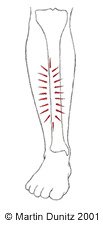
Compartment syndrome (exertional lower limb pain) is a common shin or calf injury in distance runners. It is often confused with shin splints and many people who think that they have shin splints are in fact suffering from compartment syndrome. Compartment syndrome is common in the lower leg of athletes who follow high mileage training programmes. The pain is brought on by activity, due to the anatomy of the muscles.
The lower leg is divided into compartments by a layer of fascia which encloses the muscles. The anterior compartment is at the front between the tibia (shin bone) and fibula (splint bone). It contains the muscles that pull the foot and toes up towards the knee. The medial compartment is on the inside aspect of the shin. The muscles which bend the toes during pushing off are in this compartment. The posterior compartment is the largest, and contains the calf muscles which attach to the achilles tendon and push the ankle downwards during running and jumping. The lateral compartment on the outside of the shin contains the muscles which turn the sole of the foot outward.
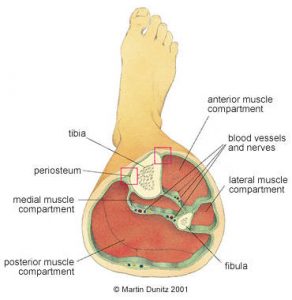
Compartment Syndrome occurs when the volume of the muscles, blood vessels and nerves become too big for the space within the compartment. This leads to an increase in pressure within the compartment and compresses all structures within the compartment. There are two main causes:
- Swelling or bleeding within the compartment due to direct trauma
- An increase in muscle size in the compartment due to physical activity
Signs & Symptoms of Compartment Syndrome
The major symptom is pain which is brought on by sport. Usually it takes about 20 minutes of running before the pain gradually rises to the point where the person can no longer continue. The pain is cramp-like and is due to the constriction of blood vessels which prevent blood and oxygen from reaching the muscles. This can lead to permanent tissue damage. Usually, however, the pain is transient and will ease with rest. In some patients the increased pressure in the compartment can be felt as taut tension within the tissues.
Diagnosis can be confirmed with MRI scans and measurement of compartment pressure. This is done by inserting a catheter into the compartment and measuring pressure with a transducer during exercise (running on the spot). Normal compartment pressures in the lower leg are between 10 and 15 mmHg. Values greater than 50mm Hg are indicative of compartment syndrome.
Compartment Syndrome Treatment
What you can do?
- Consult a sports injury expert
- Apply ice packs/cold therapy to reduce swelling
- Wear orthotics to help reduce symptoms
In cases where the pain comes on with exercise, and is relieved after rest, conservative treatment such as physiotherapy and the prescription of orthotics (insoles) may reduce the severity of the symptoms, but cannot get rid of the problem. Once a diagnosis of compartment syndrome has been confirmed through measurement of raised compartment pressure, the most effective treatment is surgery. Surgery for compartment syndrome consists of an operation called a superficial fasciotomy, which involves splitting the fascia which surrounds the muscle to open up the compartment. This relieves the pressure on the tissues within the compartment.
Superficial fasciotomy surgery for compartment syndrome should be followed by aggressive rehabilitation under the supervision of a chartered physiotherapist to prevent scar contraction as this may restrict the tissues within the compartment and therefore ruin the surgery. Ankle pumping exercises should be initiated immediately with the legs in an elevated position. Ankle pumping exercises stretch the scar tissue and help to clear swelling. Ice packs are essential to help reduce swelling and inflammation following surgery and calf guards may be useful to compress the lower leg further reduce swelling.
Depending on the wishes of the individual surgeon and depending on which compartment has been operated on, a return to normal walking is usually possible between three and five days after surgery. Partial weight bearing exercises such as cycling and cross trainer in the gym can be started immediately, with a return to jogging after 10 to 14 days.
Compartment Syndrome Prevention
High compartment pressures appear to be an attribute that some people inherit, although this problem only really surfaces when we attempt to exercise. Unfortunately, there are no preventative measures to avoid this condition. However, gradually increasing training programmes and the introduction of speed or hill work may prevent the onset. Ensuring training shoes are adequate for the surface may also help reduce the risk of compartment syndrome.