

Introduction
There is a vast array of different taping methods that can be used for problems with different anatomical locations. The exact application of each technique may be different depending on the reasoning process of the person who applied the tape. Because of the scant scientific evidence on this area and because each individual is different, there is no truly ‘correct’ method of applying tape, as each patient has a different problem.
If the tape is being applied by a Chartered Physiotherapist then a thorough examination of the problem would have been undertaken, with the clinician then applying the tape with the aim of limiting unwanted movement at a joint or offloading specific anatomical structures where a weakness has been identified. Because there are a huge number of structures that could require support there is no single definitive taping technique. Therefore, the taping featured in this guide provides an outline only, with a degree of improvisation necessary for each specific problem.
The guide reviews the published evidence on the effectiveness of taping in sports medicine, followed by a step-by-step practical guide to some of the taping techniques that are commonly used.
Effectiveness of Taping for Injury Prevention
Taping is described in the literature in the treatment and prevention of several musculoskeletal conditions such as ankle sprains (Thacker et al, 1999), patellofemoral pain (Gigante et al, 2001), wrist sprains (Rettig et al, 1997) and shoulder injuries (Kneeshaw, 2002). Research methods include randomised controlled trials, retrospective and prospective cohort studies, biomechanical lab base studies, correlational epidemiological studies. The scientific evidence for the effectiveness of taping for these problems is mixed, but the clinical use of taping techniques is widespread (Macdonald, 1994).
Miller and Hergenroeder (1990) examined the effectiveness of tape versus laced ankle stabilisers and found that support provided was equal. Each method had practical advantages and disadvantages, namely that the stabiliser could be applied by the athlete and re-tightened during competition; whereas the tape could be modified to the athletes preference and was better in sports which used low cut footwear such as a soccer boot. Hopper et al (1999) undertook a similar study, examining the difference in muscle activity and joint forces during landing when wearing an ankle brace or ankle tape. The study involved 15 elite female netball players whose landing technique was analysed using video, force plate (to measure ground reaction force) and EMG electrodes (to measure muscle activity). The authors concluded that the mechanics of landing were the same for both methods, but that the ankle brace altered muscular activity, though this was deemed not to affect function.
The ankle is the most commonly taped joint in soccer (Junge et al, 2002). There are several studies which examine the effectiveness of taping as a preventative measure. Garrick and Requa (1973) undertook a randomised controlled trial of the effects of taping on the incidence of ankle sprain in college basketball players. Those subjects who were taped every day suffered 14.7 sprains per 1000 participant games, compared with 32.8 sprains per 1000 participant games. A retrospective study by Rovere et al (1988) showed the injury incidence in students with taped ankles was 4.9 ankle sprains per 1000 participant games, compared with 2.6 ankle sprains per 1000 participant games in students wearing ankle braces. However this was another basketball study and the findings are not truly relevant to soccer as ankle braces are generally not conducive to soccer play.
The method of action of ankle taping as a prophylactic measure is unknown. Garrick and Requa (1973) demonstrated that tape becomes looser after only ten minutes and provides very little mechanical restraint after half an hour of competition. Garn and Newton (1998) and Karlsson and Andreasson (1992) have hypothesised that the benefit of taping comes from enhanced proprioceptive awareness which allows the Peroneal muscles to contract faster in a reflex response to a twisted ankle.
The type of taping technique and the choice of material used is largely based on the athletes preference, with this decision largely based on custom, superstition and comfort (both physical and mental). A couple of common preventative ankle taping techniques are demonstrated later within this guide.
Ankle tape is also appropriate following acute ankle sprain. As well as immobilisation, a compression bandage can help to limit swelling. Capasso et al (1989) compared the effect of adhesive and non-adhesive tape on ankle compression using a pressure cuff. They concluded that non-adhesive tape has to be renewed after three days, but that adhesive tape lasted 10 days. This would indicate that adhesive tape provides more compression, but it should be remembered that too much compression compromises venous blood flow, which can be counter productive in limiting swelling. There is an example of a compression support for an acute ankle sprain later within this guide.
In the mid eighties Australian physiotherapists advocated taping as a major component of the management of anterior knee pain. The reasoning behind this approach was that it improved patellofemoral mechanics and altered muscle imbalances around the knee. The evidence for this was largely anecdotal (the original research by McConnell (1986) did not contain a control group and there was no objective measure of improvement), but the technique has enjoyed widespread use. More recently more rigorous studies (Kowall et al 1996) have found no evidence to support the use of patellofemoral taping, as their randomised controlled trial found that taping did not enhance a standard physiotherapy treatment program without taping. Further research by Gigante et al (2001) using a CT scan to assess patellofemoral mechanics showed that patella taping didn’t affect patella orientation and concluded that this approach doesn’t improve anterior knee pain by changing patella position. Recently more theories from ‘down under’ advocate the use of tape to offload injured muscles – but we find that rest is the best method to offload damaged muscles.
Another taping technique that is commonly used by athletes, including elite level footballers is a ‘clasp’ over the patella tendon. This can be seen in several high profile soccer players, although it is unclear whether they are over their symptoms and simply wear the tape as a superstitious pre-match ritual. The reasoning behind this tape job is to compress the patella tendon thus restricting the force that can be exerted through it. Although the theory has very good face validity it is very difficult to provide objective evidence to support this technique, either clinically or in biomechanical studies.
Taping Materials
Some of the commonly used materials used when taping are:
Elastic Adhesive Bandage (EAB): This adheres to body contours and its elastic properties mean that it can ‘give’ a little with tissue changes.
Zinc Oxide Tape: This material doesn’t ‘give’ and is therefore ideal to provide restraint and reinforcement.
Cohesive Elastic Bandage: As the name suggests, this bandage sticks to itself, not to you. This is practical as no underwrap is required.
Underwrap: A thin foam material applied before the tape on sensitive areas.
Adhesive Remover: Solvent to help remove tape from the skin
Taping Preparation
Before attempting taping or strapping, the following important points should be noted:
- Taping should never be used as a substitute for treatment by a qualified healthcare professional. Always make sure an injury is assessed fully by a qualified healthcare professional before a taping technique is used. Taping is contraindicated if the patient has an allergy to the materials used, if there is active infection or irritation of the skin or if the circulation and/or nerve supply is compromised.
- The area to be taped should be clean and dry. Ideally the area should shaved to be free of hairs. If not, an underwrap should be used. This is particularly necessary at the back of the knee or elbow, where adhesive tape on the skin can cause irritation.
- Tape should be applied smoothly, taking care not to cause any wrinkles which can be uncomfortable for the athlete and even cause blisters.
Once applied, the tape should be checked to make sure the athlete is comfortable with it. The circulation and sensation of a taped area should be double checked. If the skin is excessively pale or blueish, cold or there is a lack of sensation, then the tape is too tight and should be removed immediately.
Following activity, a tape cutter or bandage scissors should be used to remove the tape. Adhesive remover should be used to help ease off the tape. Tape should not be left on for too long in case skin irritation or breakdown occurs.
Taping Technique
Here we take you, step by step, through a number of common taping and strapping techniques used in soccer. Broadly speaking, these techniques are applied in the following circumstances:
1. In the acute phase immediately following an injury. This is to prevent further movement which may aggravate the injury and also to provide compressive support in an effort to control the amount of swelling.
2. During the active rehabilitation period to provide mechanical support and proprioceptive feedback to the damaged joint in an effort to reduce the risk of re-injury.
The techniques illustrated within this guide should not be used instead of rehabilitation from a Chartered Physiotherapist. Rather, the techniques should be applied by, or following the advice of, a Chartered Physiotherapist to aid the rehabilitation process.
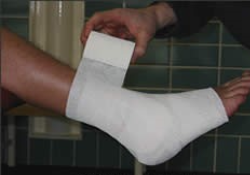
Compression strapping for an acutely sprained ankle
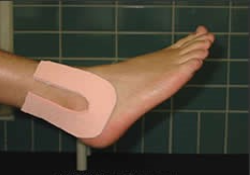
One of the first priorities in the treatment of an acute ankle sprain is to limit the amount of swelling. This strapping is designed for this purpose. As fluid typically accumulates around the malleoli, a ‘horseshoe’ of chiropody felt is used around this area.
Step 1
A horseshoe is cut from chiropody felt and placed around the lateral and medial malleoli
Step 2
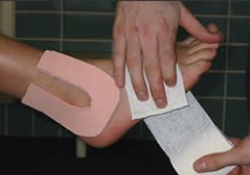
Then the bandage is applied from just above the toes
Step 3
This should be applied smoothly, covering the whole foot
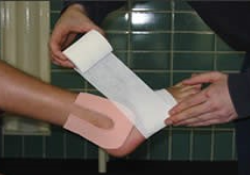
Step 4
Continue the bandage around the bottom of the heel
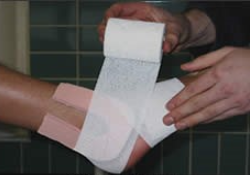
Step 5
then around the foot
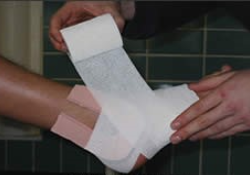
Step 6
and around the heel again, this time a little higher up
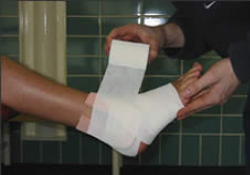
Step 7
Then around the heel again
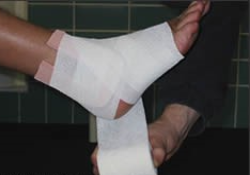
Step 8
being careful not to leave any gaps where fluid will accumulate
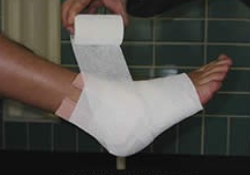
Step 9
Proceed in a smooth manner around the Achilles region
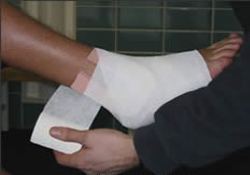
Step 10
and finish off midway up the calf, or higher up at the popliteal fossa
Preventative full ankle strapping
This ankle technique is commonly used by many elite level football players, as the direction of the tape applied can help prevent an inversion injury.
Step 1
Start in the forefoot
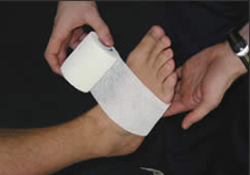
Step 2
Guide the tape diagonally up the foot
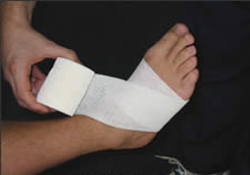
Step 3
and around the back of the heel bone
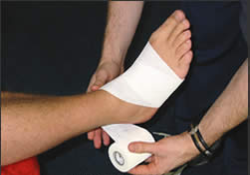
Step 4
Then come round smoothly and go over the mid-foot
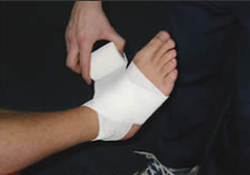
Step 5
Then under the foot and back over diagonally, a little higher this time
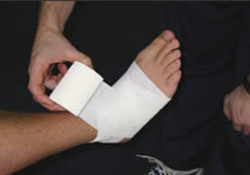
Step 6
Then go back around the heel a little higher
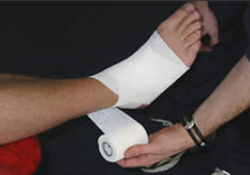
Step 7
then diagonally forwards and around the foot again
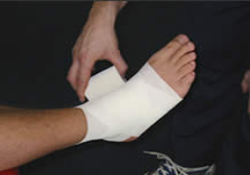
Step 8
Smooth the bandage under the bottom aspect of the heel and pull upwards, really giving support to the lateral ankle ligaments
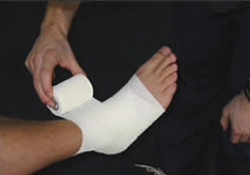
Step 9
Then come round the heel again…
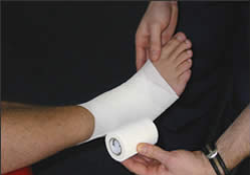
Step 10
and finish off just above the ankle
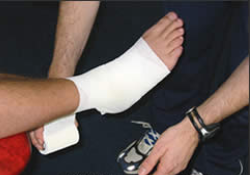
Preventative ‘Figure 8’ ankle strapping
Some football players don’t like the bandage on their heel, so the ‘Figure 8’ technique is then used.
Step 1
As with full ankle strapping, the starting point is the forefoot
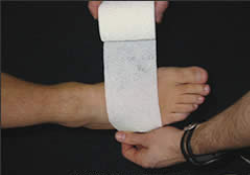
Step 2
The bandage is then taken diagonally upwards, steeply enough to go well above the heel
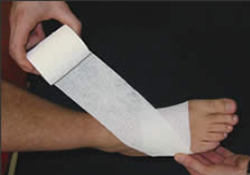
Step 3
Then around the lower calf…
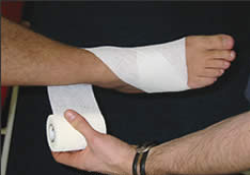
Step 4
around the lower calf…
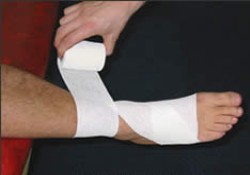
Step 5
to form an anchor
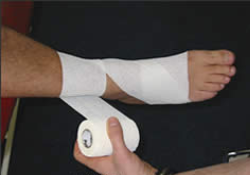
Step 6
Then diagonally down across the mid foot
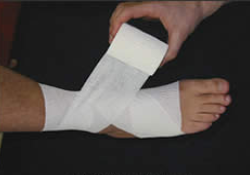
Step 7
Go around the forefoot again
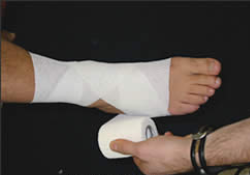
Step 8
and diagonally up to finish off around the lower calf, leaving the heel open
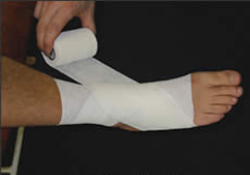
Offload taping of the Plantar fascia
Even when resting from sport, the plantar fascia can be painful when walking with plantar fasciitis. This tape technique is designed to prevent tension in this region with the aim of reducing further irritation.
Step 1
First, an anchor is placed around the heel from the lateral to medial border
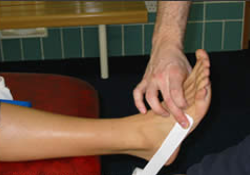
Step 2
Then another anchor in the opposite direction
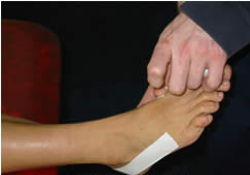
Step 3
The anchors are then linked by tape strips under the sole of the foot
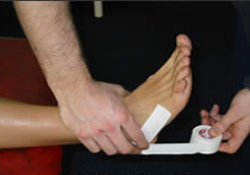
Step 4
Note how the Plantar fascia is bunched up in order to tape it in a shortened position
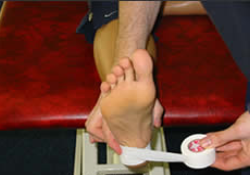
Step 5
These straps are continued towards the toes, while maintaining the tissue in a shortened position
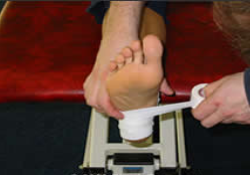
Step 6
An end strap goes right round the circumference of the foot, at the point of the end of the two anchors
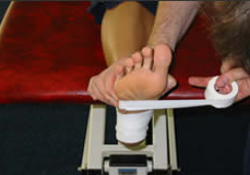
Step 7
Then another anchor goes over the torn edges of the strips…
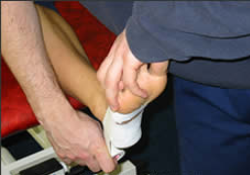
Step 8
to give a neat finish
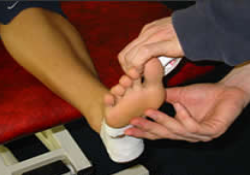
Patella Tendon Tape
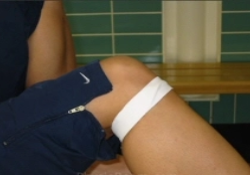
The purpose of this technique is to offload the patella tendon. This is achieved by compressing the tendon to prevent full force generation.
Step 1
The tape is applied with the knee bent. The tape starts by going circumferentially around the upper shin.
A small amount of underwrap in the popliteal fossa prevents pinching
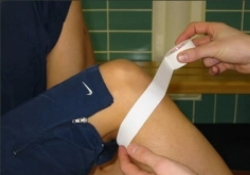
Step 2
The tape is passed round once…
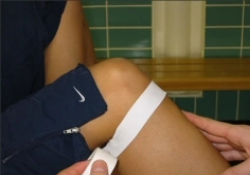
Step 3
then twisted…
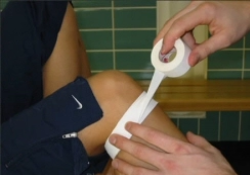
Step 4
several times…
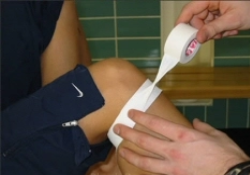
Step 5
in order to make a thicker band over the Patella tendon
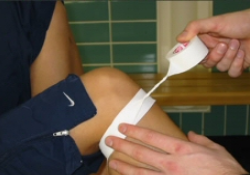
Step 6
Then the tape is passed around again…
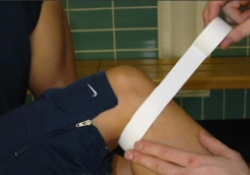
Step 7
and the twisting repeated..
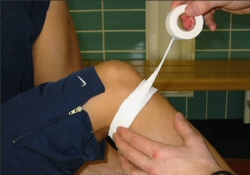
Step 8
to form a second thicker band
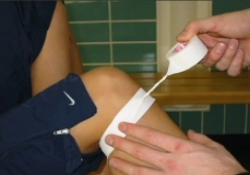
Step 9
The flat tape is passed around again…
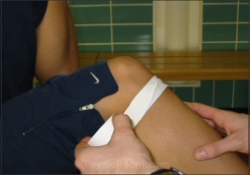
Step 10
and this time kept flat…
Step 11
to finish off
References
- Burks, R.T., Bean, B.G., Marcus, R. and Barker H.B.(1991) Analysis of athletic performance with prophylactic ankle devices American Journal of Sports Medicine Volume 19, Pages 104-106.
- Callaghan, M.J. (1997) Role of ankle taping and bracing in the athlete
- British Journal of Sports Medicine Volume 31, Pages 102-108.
- Capasso, G., Maffulli, N. and Testa, V. (1989) Ankle taping: support given by different materials British Journal of Sports Medicine Volume 23, Pages 239-240.
- Firer, P. (1990) Effectiveness of taping for the prevention of ankle ligament sprains British Journal of Sports Medicine Volume 24, Pages 47-50.
- Fumich, R.M., Ellison, A.E., Guerin, G.J., and Grace, P.D. (1981) The measured effect of taping on combined foot and ankle motion before and after exercise American Journal of Sports Medicine Volume 9, Pages 165-170.
- Garn, S.N., and Newton, R.A. (1998) Kinesthetic awareness in subjects with multiple ankle sprains. Physical Therapy Volume 68, Pages 1667 – 1671.
- Gigante, A., Pasquinelli, F.M., Paladini, P., Ulisse, S. and Greco, F. (2001) The Effects of Patellar Taping on Patellofemoral Incongruence: A Computed Tomography Study American Journal of Sports Medicine Volume 29, Pages 88-92.
- Greene, T.A. and Hillman, S.K. (1990) Comparison of support provided by a semirigid orthosis and adhesive ankle taping before, during, and after exercise
- American Journal of Sports Medicine Volume 18, Pages 498-506.
- Harradine, P. Herrington, L. and Wright, R. (2001) The effect of Low Dye taping upon rearfoot motion and position before and after exercise. The Foot Volume 11, Issue 2, Pages 57-60.
- Herrington, L. (2001) The effect of patellar taping on quadriceps peak torque and perceived pain: a preliminary study Physical Therapy in Sport Volume 2, Issue 1, Pages 23-28.
- Hopper, D.M., McNair, P. and Elliott, B.C. (1999) Landing in netball: effects of taping and bracing the ankle. British Journal of Sports Medicine Volume 33, Pages 409-413.
- Junge, A., Rosch, D., Peterson, L., Graf-Baumann, T. and Dvorak, J. (2002) Prevention of Soccer Injuries: A Prospective Intervention Study in Youth Amateur Players American Journal of Sports Med September Vol 1, ; Volume 30(5), Pages 652 – 659.
- Karlsson, J. and Andreasson, G.O. (1992) The effect of external ankle support in chronic lateral ankle joint instability. Medicine and Science in Sports and Exercise Volume 20, Pages 257 – 261.
- Kneeshaw, D. (2002) Shoulder taping in the clinical setting. Journal of Bodywork and Movement Therapies Volume 6, Pages 2 – 8.
- Kowall, M.G., Kolk, G., Nuber, G.W., Cassisi, J.E. and Stern, S.H. (1996) Patellar taping in the treatment of patellofemoral pain. A prospective randomized study
- American Journal of Sports Medicine Volume 24, Pages 61-66.
- Larsen, B., Andreasen, E., Urfer, A., Mickelson, M.R., and Newhouse, K.E. (1995) Patellar taping: a radiographic examination of the medial glide technique American Journal of Sports Medicine Volume 23, Pages 465-471.
- McConnell, J.S. (1986) The management of chondromalacia patellae: A long term solution. Australian Journal of Physiotherapy Volume 32, Pages 215 – 223.
- Mcdonald, R. (1994) Taping techniques. Practice and principles Butterworth Heinemann. Oxford.
- Miller, E.A. and Hergenroeder, A.C. (1990) Prophylactic ankle bracing. Paediatric Clinics of North America Volume 37, Pages 1175 – 1185.
- Rettig, A.C., Stube, K.S. and Shelbourne, K.D. (1997) Effects of finger and wrist taping on grip strength. American Journal of Sports Medicine Volume 25, Pages 96-98.
- Robbins, S. Waked, E. and Rappel, R. (1995) Ankle taping improves proprioception before and after exercise in young men. British Journal of Sports Medicine Volume 29, Pages 242-247.
- Rovere, G.D., Clarke, T.J. and Yates, C.S. (1988) Retrospective comparison of taping and ankle stabilisers in preventing ankle injuries. American Journal of Sports Medicine Volume 16, Pages 228 – 233.
- Thacker, S.B., Stroup, D.F., Branche, C.M., Gilchrist, J., Goodman, R.A. and Weitman, E.A. (1999) Am. J. Sports Med November 1, ; Volume 27(6), Pages 753 – 760.
- Vaes, P., De Boeck, H., Handelberg, F. and Opdecam, P. (1985) Comparative radiologic study of the influence of ankle joint bandages on ankle stability
- American Journal of Sports Medicine Volume 13, Pages 46-50.
- Warme, W.J. and Brooks, D. (2000) The Effect of Circumferential Taping on Flexor Tendon Pulley Failure in Rock Climbers American Journal of Sports Medicine Volume 28, Pages 674-678.
- Wilkerson, G.B. (1991) Comparative biomechanical effects of the standard method of ankle taping and a taping method designed to enhance subtalar stability American Journal of Sports Medicine Volume 19, Pages 588-595.
- Wright, I.C., Neptune, R.R., van den Bogert, A.J. and Nigg, B.M. (2000) The influence of foot positioning on ankle sprains. Journal of Biomechanics Volume 33, Issue 5, May, Pages 513-519.
- Yamamoto, T. Kigawa, A. and Xu, T. (1993) Effectiveness of functional ankle taping for judo athletes: a comparison between judo bandaging and taping British Journal of Sports Medicine Volume 27, Pages 110-112.