


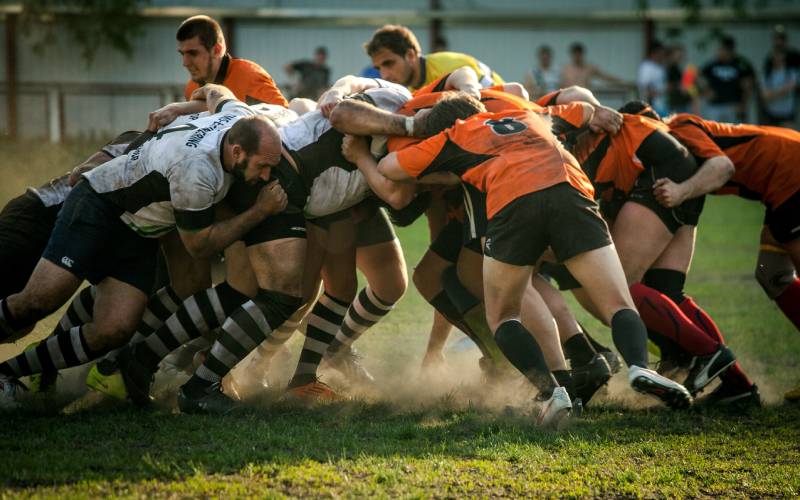
Elite level rugby union turned professional in 1995. The move to full time training has meant that the game has become more physically demanding as the players’ fitness level has improved.
The changing physical demands have seen a change in the nature of injuries. Increased emphasis on fitness training and a faster match tempo has lead to a rise in the number of muscle and tendon injuries.
Because of the frequent physical contact, the incidence of collision injury is relatively high with the upper limbs and head most frequently injured.
Recent research described the incidence of injury in rugby union as 17 injuries per 1000 hours of playing, with match injuries much more frequent than training injuries.
During matches, most injuries occurred whilst being tackled, whereas most training injuries occurred during endurance running and contact activities.
1. Hamstring Strain
Full time training in the professional rugby union era has resulted in the players being fitter and more mobile than ever before. The increased physical demands have lead to an increase in the number of lower limb muscle injuries, particularly hamstring strains, which was the most common injury to affect England’s 2003 World Cup winning squad.
During sprinting activities, the hamstring muscle can be forcibly stretched beyond its limits and the muscle tissue becomes torn. A tear in a muscle is referred to as a strain and, depending on its severity, is classified as a first, second or third degree strain.
What can you do to prevent a Hamstring Strain?
A warm up prior to matches and training is thought to decrease muscle strain injuries because the muscle is more extensible when the tissue temperature has been increased by one or two degrees. A good warm up should last at least 20 minutes, starting gently and finishing at full pace activity. Practising sport specific activities helps tune coordination and prepare mentally for competition. We recommend compression shorts for providing extra warmth around the hamstring region.
What should you do if you suffer a Hamstring Strain Injury?
The immediate treatment of any muscle injury consists of the RICE protocol – rest, ice and compression and elevation. We recommend the use of an ice bag for the safe application of ice (never apply ice directly to the skin). All injuries should be reviewed by a doctor or chartered physiotherapist. Depending upon the severity of the hamstring injury, the leg must be rested from sporting activity for between a couple of weeks and 3 months.
2. Head Injuries
Head injuries range from superficial facial and scalp lacerations, and broken noses to severe concussions. Some researchers have reported that they account for over 20% of all rugby injuries.
What can you do to prevent Head Injuries?
Rugby headgear is typically a soft helmet that covers the forehead, skull and ears. In Japan these items are compulsory during rugby union. Research has shown that headgear is effective in reducing the incidence of superficial head injuries, such as lacerations.
What should you do if you suffer a Head Injury?
All head injuries should be assessed by a doctor as soon as possible. Lacerations and broken noses can be dealt with by doctors in the emergency department. International Rugby Board (IRB) Rules state that ‘a player who has suffered concussion shall not participate in any match or training session for a minimum period of three weeks from the time of injury, and may then only do so when symptom free and declared fit after a proper medical examination.’
3. Ankle Sprain
A sprained ankle is one of the most common injuries caused by participation in sports. It refers to soft tissue damage (mainly ligaments) around the ankle, usually caused when the ankle is twisted inwards.
As well as damage to the ligaments, the capsule that surrounds the ankle joint can also be damaged. The damage causes bleeding within the tissues, which produces a swollen ankle that can be extremely painful.
What can you do to prevent Sprained Ankles?
Taping and bracing the ankle can help to reduce the risk of ankle sprains. Previous research has shown the injury incidence in people with taped ankles was 4.9 ankle sprains per 1000 participant games, compared with 2.6 ankle sprains per 1000 participant games in students wearing ankle braces. This compared with 32.8 ankle sprains per 1000 participant games in subjects that had no taping or bracing. The use of an ankle brace is a convenient alternative to taping the ankle.
What should you do if you suffer a Sprained Ankle?
In the first few days following an ankle sprain it is important to follow the RICE protocol – rest, ice, compression and elevation (never apply ice directly to the skin). Ice packs for a period of twenty minutes every couple of hours may help with the pain but pain-relieving medication may also be necessary. It is important not to put too much weight on the damaged ankle, so walking should be avoided if it is painful.
Rehabilitation with a chartered physiotherapist significantly improves the level of ankle function. Wobble board training is designed to assist the re-education of the proprioceptive system. Previous research has suggested that patients with ankle instability who underwent wobble board training experienced significantly fewer recurrent sprains during a follow-up period than those who did not follow the training programme.
4. Acromioclavicular Joint Sprain
The acromioclavicular joint (AC joint) is part of the shoulder complex. It is situated at the outside point of the collar bone where it attaches to the front of the shoulder blade. An AC joint sprain refers to damage to the ligaments of the joint. The AC joint ligaments are most commonly damaged through a fall onto the tip of the shoulder, although during rugby this force may come from a collision with an opponent in a tackle.
What can you do to prevent a AC Joint Sprain?
Shoulder bracing and taping can reinforce the ligaments of the AC joint. Many Rugby players find that the reassurance provided by a shoulder support can also be helpful. However, because of the collision nature of Rugby, it is impossible to totally prevent these injuries.
What should you do if you suffer an AC Joint Sprain?
In the initial stage of the injury pain-relieving medication is helpful. Ice packs should be applied to the injured shoulder for 20 minutes every two hours (never apply ice directly to the skin).
A chartered physiotherapist can apply a taping technique, which will push the collar bone downwards, and in more severe AC joint sprains the shoulder may be put in a sling and rested. In more minor AC joint sprains, where there is only a small amount of ligament damage, it may be possible to resume Rugby activities in 7-10 days.
5. Fractured Dislocation of the Thumb
This injury was described by Dr Edward Bennett, who suffered a fracture dislocation of his thumb while horse riding in 1885, and is often referred to as a ‘Bennett’s fracture’.
Anatomically it is a fracture of the joint surface between the thumb and the wrist and subsequent detachment of the deep ligaments, which normally stabilise the joint.
Because of the long term problems and functional instability that can occur, many orthopaedic consultants advocate surgical fixation to repair a Bennett’s fracture dislocation of the thumb.
What can you do to prevent a Fracture Dislocation of the Thumb?
Not a great deal. Get your chartered physiotherapist to tape your thumb, but even then a fracture dislocation of the thumb may occur due to the collision nature of rugby.
What should you do if you suffer a Fracture Dislocation of the Thumb?
This is a nasty injury, with potential long term functional impairment of hand function. All fracture dislocations of the thumb should be assessed by an orthopaedic consultant.
In the first few days following a fracture dislocation of the thumb it is important to follow the RICE protocol – rest, ice, compression and elevation (never apply ice directly to the skin). Ice packs for a period of twenty minutes every couple of hours may help with the pain but pain-relieving medication prescribed by a doctor may also be necessary.
Surgery is often required for this injury and the surgeon may immobilise the thumb in a plaster. Once this is removed, some form of protection for the joint is necessary during the rehab period. A thumb stabiliser is helpful to protect the joint between exercise sessions with a physio.