

What is a Mallet Finger Injury?
Mallet finger is a common finger injury in sports such as cricket, baseball, rugby and American football. Mallet finger is characterised by finger pain and a swollen finger but, most of all, by the mallet finger deformity’ at the end of the finger. Mallet finger is caused by the rupture of the long extensor tendon of the extensor digitorum muscle (the muscle that straightens the fingers), at its insertion into the distal phalanx (finger tip bone) of the finger. The tendon may also avulse (pull away) a piece of bone from the distal phalanx.
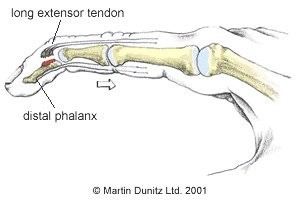
The mallet finger deformity may occur as a result of rheumatoid arthritis, which will be diagnosed by a blood test, or, more commonly, following trauma. A common cause of this injury is a blow to the end of the straightened finger. Two implements that may produce this injury are a mallet or baseball, which is why it is often known as baseball finger in the United States.
Mallet Finger Signs & Symptoms
There will be finger pain and a swollen finger. Most noticeable however, the person with mallet finger will present with a deformity whereby the end of their finger is bent and they are unable to straighten it out using their own effort. The affected finger can be straightened out with the other hand. The area where the long extensor tendon inserts into the bone will be painful and swollen. If a piece of bone has been avulsed, an x-ray may reveal this.
What you can do
- Consult a sports injury expert
- Apply cold therapy to relieve pain
- Wear a finger splint to aid healing
- Regain dexterity with therapeutic putty
- Relieve finger stiffness with hand therapy balls
- Improve finger & grip strength with resistance exercises
- Wear a finger splint for protection
- Tape fingers for protection during sports
Mallet Finger Treatment
The majority of mallet finger injuries are treated conservatively with physiotherapy. Ice packs can be useful to relieve pain in the early stages. The terminal interphalangeal joint (the joint in the finger closest to its tip) should be splinted in slight hyperextension (an overly straightened position), without immobilising any of the other joints of the injured finger, using a finger splint. This position should be maintained undisturbed for 6 weeks.
After this, the finger splint is worn for a few more weeks but can be removed for physiotherapy treatment. Physio treatment includes exercises to slowly regain mobility and strength in the injured finger, which should be practised several times each day. Exercises using hand therapy balls and therapeutic putty can be very helpful to regain mobility. Grip and finger strengthening devices can also be useful to restore normal hand and finger strength.
Surgery is rarely required for mallet finger, but if a piece of bone has been avulsed, then surgical fixation may be necessary. If the individual plays sport to a high level, such as cricket, baseball or similar, then surgery may also be indicated to return to such a standard of play. The surgeon uses two wire pins to fix the bone back in place. These pins can be removed after two and then four weeks, after which physiotherapy treatment can resume.
Mallet Finger Prevention
In sports such as baseball, cricket, rugby and American Football it may be sensible to tape the fingers to provide further support to the joints. In individuals with a history of mallet finger injury it is wise to wear a finger splint as protection. Some research has indicated that there may be a family history of mallet finger due to weakness in the extensor tendon of the finger. Finger and grip strength exercises using a strengthening device may be effective.