

What is a Colles Fracture?
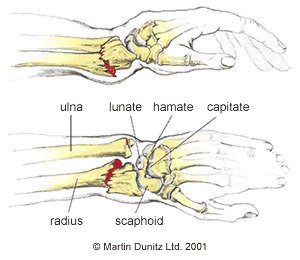
A broken wrist is common following a fall on an outstretched hand. A Colles fracture is a fracture of the radius bone of the forearm, just above the wrist (a Scaphoid fracture is the other common type of wrist fracture). Symptoms include a great deal of wrist pain, a “dinner fork” deformity, wrist swelling and an inability to use the wrist and hand. The term Colles fracture originated with the Dublin doctor Abraham Colles, who first described this common type of wrist fracture in 1814.
Falls that cause wrist fractures are common during skiing and snowboarding in particular where falls at high speed are common. The natural response to a fall is to stretch out a hand to break the fall, and falls tend to occur more often in beginners. For this reason, a broken wrist is a relatively common feature, with around 100,000 wrist fractures worldwide among snowboarders each year.
Broken Wrist Signs & Symptoms
As you would imagine with a fracture, there is a great deal of wrist pain. The aforementioned ‘dinner fork’ deformity is usually present, named so as it resembles a dinner fork when viewed on X-ray from the side. Together with wrist swelling and bruising, as a result of the fracture, there is an inability to use the wrist and hand. In most Colles fractures the patient will hold the affected wrist towards their body in an effort to protect it. Diagnosis is confirmed by an x-ray.
Broken Wrist Treatment
- Consult a sports injury expert
- Apply cold therapy to relieve pain
- Wear a removable wrist support for protection
- Regain dexterity with therapeutic putty
- Relieve wrist stiffness with hand therapy balls
- Improve hand & grip strength with resistance exercises
- Use a bone healing system to speed up broken bone healing
If a fracture of the wrist is suspected, the patient should be taken to an accident and emergency department without delay. Ice packs may be helpful to relieve pain, reduce swelling and limit bruising.
If a Colles fracture is confirmed on x-ray, the initial treatment will be supervised by the doctor in the emergency department. If the two fragments of broken bone are shown to be close together, and well-aligned, the treatment is simply to immobilise the wrist in a cast for 6 weeks. For the first 72 hours after the injury, the wrist should be elevated to reduce swelling.
However, if the x-ray shows that the two fragments of bone are displaced away from each other, or not well aligned, then the emergency department doctor will have to manipulate the fragments back into position. This procedure is done under anaesthetic and once the bone has been repositioned, the forearm and wrist will be immobilised in a plaster for 6 weeks. The wrist should be x-rayed again after 2 weeks to make sure that the bone is still well aligned. Depending on the preference of the treating doctor it may be possible to use a removable wrist splint from two or three weeks so long as the x-ray shows that the bone is healing well.
Removable wrist supports provide the same degree of protection as a conventional plaster, but are much lighter and therefore more comfortable to wear for day to day activities. The fact that they can be removed allows washing of the wrist region, making it much more hygienic than a conventional plaster which allows the user to keep the skin in good condition.
Rehabilitation begins immediately by maintaining the range of movement in the shoulder, elbow, fingers and thumb, on the side of the affected wrist. This prevents secondary stiffness in these areas and helps to resolve swelling in the wrist. Assuming that there are no complications with healing, the plaster can usually be removed after 6 weeks, if the doctor is satisfied that the bone has united and healed itself. At this stage, more active rehabilitation can be undertaken.
Exercises in warm water are helpful to improve the hydration of the skin if it was encased in a plaster of Paris. These also encourage the patient to gently begin moving the wrist in all directions, relieving stiffness. Exercises using therapeutic putty, hand therapy balls and grip strengtheners can add strength to the intrinsic muscles around the hand and wrist and resolve wrist swelling. In the period following the removal of the plaster, it may be helpful to wear a wrist support when not doing the exercises and when reintroducing activities that involve wrist movement.
Broken Wrist Prevention
Snowboarders should wear wrist guards as they significantly reduce the incidence of wrist injuries during falls. These are available from all good ski shops