


What is Elbow Arthritis?
Elbow arthritis (osteoarthritis) is not a common elbow injury, as the elbow is not a weight-bearing joint. Elbow arthritis occurs most often secondary to trauma such as a broken elbow or due to repetitive use in sports such as tennis or golf. The initial trauma of a fracture changes the mechanics of the elbow joint and sets off a process of progressive elbow joint degeneration. Middle aged men with the history of an elbow fracture are most often affected by elbow arthritis. People who use power tools for prolonged periods are also predisposed to elbow arthritis. In order to fully understand arthritis of the elbow, it is helpful to review the anatomy of the elbow joint.
The elbow is a hinged synovial joint between the upper arm (humerus) and the forearm (ulna and radius). The widest bony points of the upper arm are just above the elbow joint and are called the medial and lateral epicondyles. The outer part of the upper arm at the elbow joint is known as the capitellum, which forms a joint with the head of the radius. The inside of the upper arm at the elbow joint is known as the trochlea, which forms a joint with the trochlear notch of the ulna. The radius and ulna also form a joint with each other known as the ‘proximal radio-ulna’ joint.
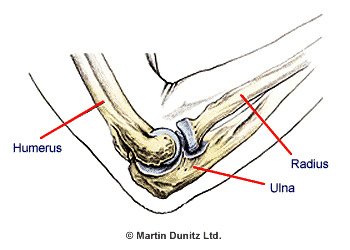
Apart from the bending and straightening movements at the hinge of the elbow joint, the proximal radio-ulna joint produces rotation of the radius which is very important for movements of the wrist and hand. If any of the complicated joint surfaces of the elbow region become damaged by trauma or overuse then there is danger of developing arthritis of the elbow joint.
Like all joints, the ends of the bones of the elbow joints are covered in hyaline cartilage. The hyaline cartilage is ultra smooth to allow friction free movement. However, early damage to the superficial layers produces a frayed appearance. In time, with more stress, this frayed surface evolves into cracks or ‘fissures’ in the articular cartilage, which can leave the underlying bone exposed to the point that there is bone on bone contact.
With continued overuse of the elbow joint there are changes in the Hyaline cartilage and underlying bone, as well as the soft tissues that surround the elbow. As the joint becomes deformed by bony changes the ligaments which support the joint become stretched.
Signs & Symptoms of Elbow Arthritis
Elbow pain is the most common symptom of elbow arthritis and can radiate down the forearm or up to the shoulder. There is often a grating noise that accompanies elbow joint movement, which is a result of a loss of the smooth hyaline cartilage. As elbow arthritis progresses, loose pieces of cartilage or bone may get jammed in the elbow joint and cause a restriction of movement, sometimes causing “clunks” or locking at the joint. Because the elbow joint is restricted, fluid can accumulate in the joint and cause pressure on the ulnar nerve. This causes pins and needles and tingling in the little finger and ring finger. The diagnosis of elbow arthritis is confirmed with an x-ray which is characterised by a loss of joint space between the two bones.
People with elbow arthritis often ‘overdo it’, either in sport or during work activities, and they will experience a flare up from the degenerate joint. This flare up may last for 48 hours and usually consists of stiffness (particularly in the morning) and pain in the affected joint. Flare ups will settle with rest and the use of NSAID’s (non steroidal anti inflammatory drugs) prescribed by a doctor. Ice therapy and cryotherapy can also be helpful.
A substantial time period may pass before there is another flare up, but typically each flare up will get progressively more intense. The time interval between flare ups will decrease to the point where, eventually, the person will have pain even at rest. As the disease progresses the symptoms that start off being triggered by over activity, become triggered by immobility. Whereas, in the early stages, rest is essential during a flare up period, disuse in the later stages will exacerbate the problem.
In the later stages, if there is pain at rest and during the night, as well as problems with mobility, then elbow joint surgery may be appropriate. Elbow arthroscopy (key hole surgery) has developed greatly in the last few years. This technique allows loose fragments of bone and cartilage to be removed in order to restore normal elbow function. Elbow arthroscopy is much less invasive than conventional elbow joint replacement surgery and has been demonstrated to decrease pain and improve range of motion.
Elbow joint replacement takes place under a general anaesthetic. It involves an orthopaedic surgeon replacing the humerus and ulna joint surfaces of the elbow joint with a metal hinge. Elbow rehabilitation with a physiotherapist begins immediately and full elbow range of motion is usually achieved after 6 weeks.
Elbow Arthritis Treatment
- Consult a sports injury expert
- Apply ice packs/cold therapy
- Apply compression to reduce pain & limit swelling
- Wear an elbow support
- Use exercise bands to maintain elbow strength
- Use therapeutic putty & hand therapy balls for dexterity
Patient education is one of the most effective treatment strategies for elbow arthritis. By understanding the nature of osteoarthritis the patient can make adjustments to their lifestyle that will make the problem more manageable. In summary, the patient must understand that too much activity or too little activity will make the problem worse. Each individual is different but, over time and through experience, each person will learn the optimum level of activity for their elbow joint. Identifying activities which exacerbate the pain will greatly help in managing this progressive condition.
During the early phase, flare ups are best treated symptomatically. NSAIDs prescribed by a doctor are effective in relieving pain. Anti-inflammatory gel can also help elbow pain and doesn’t have the side effects associated with anti-inflammatory tablets. An ice pack may be used to relieve a hot painful elbow joint. Ice packs can be applied for periods of twenty minutes every couple of hours (never apply ice directly to the skin as it can cause an ice burn). At home cryotherapy cuffs can be used to provide continuous ice and compression to the elbow joint. It can relieve pain and reduce inflammation within the tissue.
Many people find that wearing a neoprene elbow support can help provide support and reassurance. As elbow arthritis tends to be more painful during cold winter months, a neoprene support is often helpful as it provides soothing warmth to the joint.
Once arthritis of the elbow has been formally diagnosed a more long term preventative strategy can be undertaken. This is aimed at reducing pain and stiffness and maintaining range of movement in the affected joint. A sensible approach can prevent excessive degeneration which may eventually lead to disability. Adjusting activities of daily living or reducing painful movements is the key in managing arthritis of the elbow. Sporting activity may have to be reduced or adapted if it aggravates the condition, for example throwing sports or tennis.
Each individual case is different and a full assessment by a chartered physiotherapist will identify factors that may exacerbate the problem. Where the elbow joint is affected maintenance of full range of motion is encouraged to reduce stiffness. Elbow movement can be lost if the person doesn’t use the full range of motion because of pain. A physiotherapist can use manual techniques to help maintain the range of movement. Massage and stretching can help to relieve elbow pain and restore function.
Pain in the elbow joint can lead to weakness in the forearm muscles. This can lead to a loss of grip strength. Exercises to maintain forearm muscle strength are encouraged to provide support for the affected joint. This strengthening should be done under the supervision of a physiotherapist. Exercise bands, grip strengtheners, therapeutic putty and hand therapy balls can all be used to maintain grip strength and dexterity.
Elbow Arthritis Prevention
Repetitive elbow movements and prolonged work with tools should be avoided, as should keeping the elbow in one position for a period of time. Frequent breaks should be taken to stretch and take the elbow, wrist and shoulder joints through their full range of motion, as the hyaline cartilage draws most of its nourishment from the synovial fluid within the joint, and this has the effect of providing nutrients to the joint surfaces.